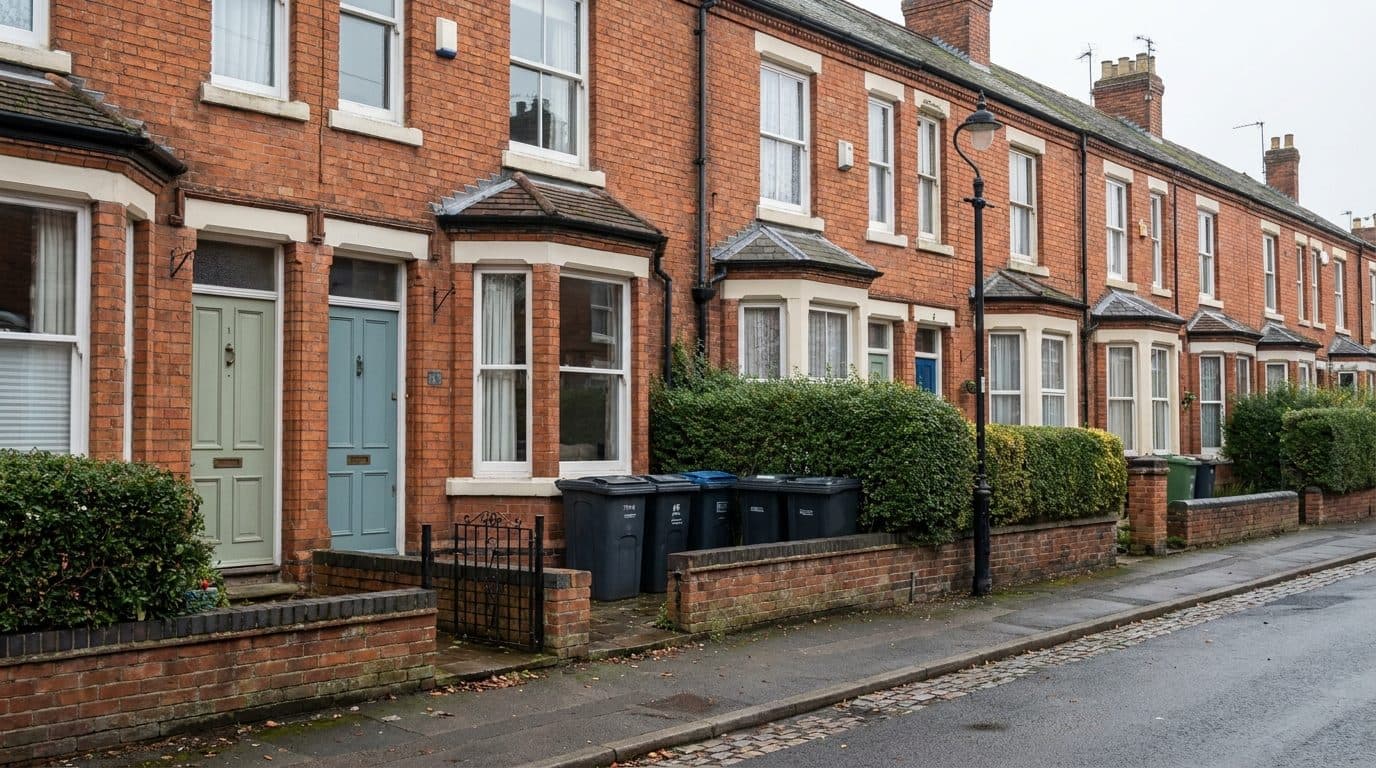
A row of red-brick Victorian terraced houses on a Lincoln street, one with a for-sale board

Energy · Launching · Selling a house

Not yet taking bookings

The EPC comes before the listing.

A property cannot be marketed for sale without an EPC commissioned, and the certificate has to be shown to anyone who asks. What buyers read into the rating, and how to stop a bad one costing you at offer stage.

Needed
Pre-listing
Valid for
10 yrs
No EPC penalty
£200
Planned price
£69

Before the Board Goes Up

Three things sellers get wrong.

The certificate is cheap and quick. Getting it late, or ignoring what it says, is what costs.

S.01

Ordering it after the listing

The law says an EPC must be commissioned before marketing starts and obtained as soon as possible after, within a window measured in days. Agents will not list without one on order, so the assessment sits on the critical path to launch.

S.02

Assuming the old one is fine

Certificates last ten years. If the house was sold or let before, there may be a valid one on the register already; check by postcode in a minute. If it has expired, or the house has changed since, you need a new one.

S.03

Ignoring a low rating

Buyers see the band on every portal listing. An F or G invites a discount, a lender may ask questions, and a buy-to-let buyer cannot let it below an E. A few cheap measures before the assessment can move the band and the conversation.

The Rating · Illustrative

What the buyer sees.

An illustrative 1930s semi: an E on the day, a C if the listed measures were done. The buyer sees both numbers, and the gap between them is what a good agent talks about at the viewing.

Illustrative · 1930s semi · Current rating E · Potential rating C

A
B
C
Potential
D
E
Current
F
G
Cavity wall insulation
Loft insulation topped up to 270mm
Condensing boiler with modern controls

When you need one

Under the Energy Performance of Buildings (England and Wales) Regulations 2012, a dwelling put on the market for sale needs an EPC commissioned before marketing begins, and the seller or their agent has to make it available free of charge to any prospective buyer. Failing to do so is a fixed penalty of £200 per dwelling, and more to the point, no agent will list without it.

The certificate belongs to the property, not to you. If a valid one exists on the national register from a previous sale or let, you can use it, as long as it still describes the house as it is now. A house that has since been extended, re-roofed, re-glazed or given a new heating system deserves a fresh assessment, because the old rating will undersell it.

A few buildings are exempt: places of worship, some temporary buildings, and stand-alone buildings under fifty square metres. Listed buildings are a grey area that most sellers resolve by getting one anyway; if compliance with the recommendations would unacceptably alter the building's character, that is a matter for advice, not a reason to skip the certificate.

Check the register first

The government's find-an-energy-certificate service lists every EPC lodged in England and Wales, searchable by postcode. Before you order one, look.

What to look for

  • The expiry date: ten years from the lodgement date, to the day
  • Whether it describes the house as it is: number of rooms, heating type, glazing, extensions
  • The rating and the potential rating: if the potential is two bands higher, the recommendations are the cheap kind
  • Whether the address is right: flats and converted houses are often lodged against the wrong unit

What buyers read into the rating

The band is on the listing, next to the price. Most buyers do not read further, so the letter does the talking. A C is a selling point in older stock and the portals let buyers filter on it. A D is unremarkable and typical of Lincoln's older houses. An E is a question at the viewing. An F or G shrinks the buyer pool, because a landlord cannot let it without works and a lender may want to know why.

The estimated energy costs on the certificate are read too, and they are calculated for a standard household rather than yours, so they can look alarming for a large old house. A buyer's surveyor will often echo the EPC's recommendations in their own report, which is one reason to do the cheap ones before you list rather than after an offer.

Quick wins before the assessment

The assessor records what is there on the day. A box of LED bulbs fitted the week before counts; a plan to fit them does not. If you are a month from listing, these are the measures that move a band for the least money and the least mess.

  • LED bulbs in every fitting, because the assessment counts the proportion of low-energy lighting
  • Loft insulation topped up to 270mm if it is thin, patchy or missing
  • A room thermostat, a programmer and thermostatic radiator valves if any are absent
  • An insulating jacket on a hot water cylinder that has none
  • Draught-proofing on external doors and any single-glazed windows
  • The paperwork: a boiler installation certificate or a cavity insulation guarantee is evidence the assessor can use for what they cannot see

Not yet live. Nothing is assessed or lodged until it is.

An EPC can only be produced and lodged by an accredited Domestic Energy Assessor. We are building that arm and will not take a booking until the accreditation is on record. Register interest and you get one message on launch day and nothing else. If a sale is waiting on a certificate now, any accredited assessor can lodge one; the inspection reports and check-ins and check-outs we already do are available today.

?Selling a house · Questions

Asked & answered.

Yes, with very few exceptions. One must be commissioned before the property is marketed and made available to buyers free of charge. If a valid certificate already exists on the register and still describes the house accurately, that one counts.

Marketing can start once the EPC has been commissioned, and the certificate then has to be obtained as soon as reasonably possible, within a legal window of days. In practice agents want it in hand before the listing goes live because the band appears on the portal.

Around forty minutes on site for an average house. The assessor needs to see every room, the loft if there is a hatch, the boiler, the hot water cylinder, the meters and the windows. The certificate is lodged on the register afterwards, usually the same day.

No. Plenty of E- and F-rated houses sell. What it does is narrow the buyer pool and give the buyer something to negotiate on, especially if their surveyor repeats the EPC's recommendations. Doing the cheap measures first takes that lever away.

No. An EPC is an energy assessment of the fabric and services on a standard method. It says nothing about condition, defects or value. The buyer's survey is a separate report commissioned by the buyer.

Not yet. EPCs launch once our assessor accreditation is in place. Until then nothing is assessed, lodged or charged. If your sale is waiting on one now, any accredited Domestic Energy Assessor can lodge it within days.

Register interest.

Tell us the property and when you plan to list. One message when EPCs go live.

Register Interest